

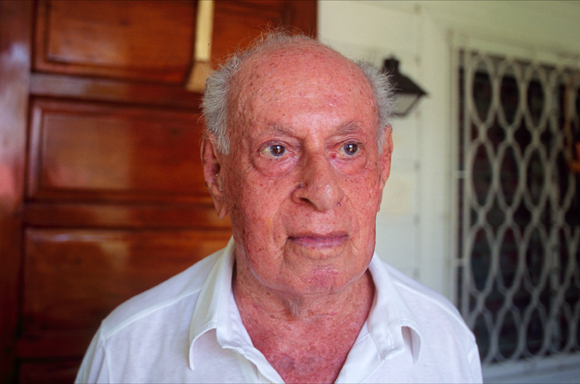
A Founding Jewish Settler in Sosua: Luis Hess The son of a successful entrepreneur in Germany, Luis Hess was forced to leave his life behind in Erfurt and start again in the Balearic island of Ibiza, in Spain. Civil war broke in Spain in 1936 and Mr. Hess was once again on the lookout for safer lands, going to France and getting a job in Paris. IN 1939, his residency permit expired and no renewal was offered, so he had to find an alternative. He found out about the DORSA, an association established for the resettlement of Jews in the Caribbean island of Dominican Republic, and soon he departed from France to the Dominican Republic. Upon arriving to the island, Mr. Hess soon departed to the capital of the Dominican Republic, Santo Domingo. There he found a job as a teacher and translator. He later worked for the DORSA, and soon became a main contact between the Jewish community and the local government. Mr. Hess was the first Jew to marry a non Jewish local from the Dominican Republic, and was highly criticized by his community. Despite that, he became a teacher and later the director of the Cristobal Colon school, that was later renamed Luis Hess, in honor of Don Luis. Mr. Hess passed away on February 8, 2010 and he was 102 years old. Sosua`s beloved honorary citizen was buried next to his wife, Ana Julia. |
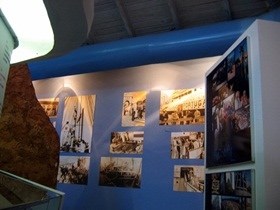
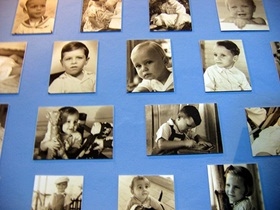
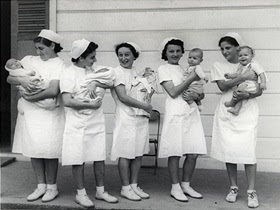
The Jewish Museum in Sosua has an exhibition of black and white photographs depicting the lifes of the Jews that gave shape to what is today a thriving community. Marion A. Kaplan, a professor of modern Jewish history at New York University and the author of “Dominican Haven: The Jewish Refugee Settlement in Sosúa, 1940-1945” (Museum of Jewish Heritage), the exhibition’s companion volume, puts the story in context. “In comparison,” Kaplan writes, “about 100,000 Jews reached Latin America and the Caribbean between 1933 and 1942, and about 160,000 came to the U.S. between 1933 and 1942.” Kaplan adds: “But numbers do not convey the full story. The United States, for example, only once fulfilled its yearly quota of German-Austrian immigrants between 1933 and 1944, and that was in 1939, after the shock and empathy that emerged in response to the open violence against Jews in Germany on November 9, 1938, known as the November Pogrom, or Crystal Night.” At the museum entrance is the text of the 1940 agreement between the Trujillo dictatorship and the Dominican Republic Settlement Association (Dorsa), the New York-based organization that intended to rescue thousands of Jews from impending doom in Austria, Germany, Poland, Hungary and Czechoslovakia.
|
An important exhibition of the Museum of Jewish Heritage in New York was inaugurated in February 17-July 25, 2008 showing photographs, artifacts, memorabilia and documents representing the migration of the jews to the Dominican Republic starting in 1940 and the creation of Sosua as a Jewish settlement. This particular effort had the support of State Senator Eric Schneiderman, the American Jewish Congress, the American Jewish Joint Distribution Committee and other important Jewish-American organizations. See the details of the exhibition in the Museum of Jewish Heritage website: http://www.mjhnyc.org/final/ Survivors of the Holocaust: Martin Katz
A Story in Pictures: The Sosua Jewish Museum Exhibits
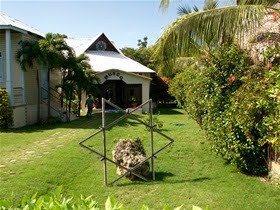
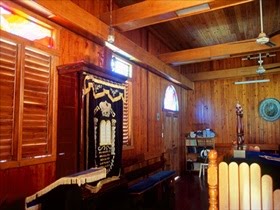
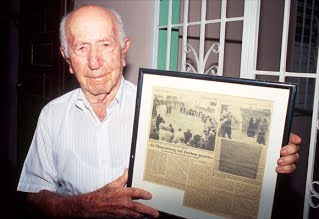
Faded clippings with articles and old documents are displayed on a wall of the museum, witnessing the history of the refugees . One wall of the Museo Judio contains faded news clippings such as a May 11, 1940, article from the New York Times entitled "Exiles on Last Lap to Dominican Site," while another showcases sepia prints by La Nación photographer Kurt Schnitzer and original paintings by artist Ernesto Loher — both children of Jewish refugees who settled in Sosua. There's also a colorful stained-glass Star of David and a chart extending from ceiling to floor, listing the names of settlers, the date each arrived and their country of origin. Artifacts on display include a large wooden menorah crafted by hand in the colony's carpentry shop; a scale used in Erich Sygal's pharmacy; an original telephone switch from the Dorsa offica; a branding iron used to mark cattle, and a metal milk container from the Productos Sosua dairy. The Synagogue Next to the Sosua Jewish Museum there`s the synagogue, the original wood-frame synagogue used by the refugees. It is used by the few remaining Jews still in Sosua, and like the museum, it is necessary to call before visiting because it is not open with a regular schedule. The author of this document had to visit a nearby office belonging to one of the oldest Jewish families here, the Strauss. I was told they kindly open the museum to any visitors, and the office is just 20 meters away next to the banco Popular and Bailey`s cafe. |


